Together, we solve the challenges of tomorrow.
DISCOVER →Ground improvement in League City represents a critical geotechnical discipline that addresses the fundamental challenge of constructing on the region's notoriously weak and compressible soils. This category encompasses a suite of engineering techniques designed to enhance the load-bearing capacity, reduce settlement potential, and mitigate liquefaction risks in native subsurface materials. For a community situated along the Texas Gulf Coast, where urban expansion and infrastructure demands continue to grow, the ability to reliably improve ground conditions is not merely a technical option but a foundational necessity for safe and sustainable development.
The local geology of League City is dominated by the Beaumont Formation, characterized by Quaternary-age clay, silt, and fine sand deposits laid down in ancient fluvial-deltaic environments. These soils typically exhibit high plasticity, significant shrink-swell behavior, and low shear strength, particularly in the upper 15 to 30 feet. The shallow groundwater table, often within 6 feet of the surface, compounds these challenges by maintaining saturated conditions that amplify settlement and complicate excavation. These geotechnical realities demand specialized improvement solutions that go beyond conventional shallow foundations to ensure long-term structural integrity for both residential and commercial projects.
Design and execution of ground improvement in the United States, and specifically in Texas, must conform to a framework of standards led by the International Building Code as adopted by the City of League City, alongside geotechnical specifications from the American Society of Civil Engineers, notably ASCE 7 for load combinations and settlement tolerances. The Texas Department of Transportation also provides relevant guidelines for public infrastructure, while the American Society for Testing and Materials governs material and testing procedures. Adherence to these norms ensures that improvement designs meet rigorous performance criteria for bearing capacity, total and differential settlement, and seismic resilience where applicable.
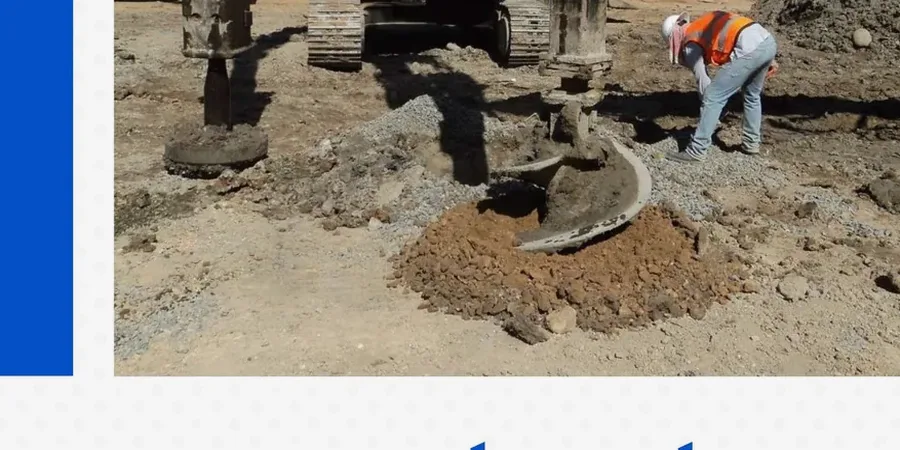
The types of projects that routinely require ground improvement in League City are diverse, ranging from light commercial buildings and big-box retail centers to essential civil infrastructure such as roadway embankments, stormwater detention basins, and bridge approaches. Deep improvement methods like stone column design are frequently specified to support heavily loaded structures by creating stiff, draining inclusions that accelerate consolidation and increase composite shear strength. For granular deposits or sites requiring densification without introducing imported aggregate, vibrocompaction design offers a proven solution to reduce void ratios and mitigate potential settlement. These techniques are often integrated into a comprehensive geotechnical strategy that may also include surcharging, chemical stabilization, or rigid inclusions depending on the soil profile and structural demands.
Ground improvement refers to the modification of native soil properties to enhance engineering performance, including strength, stiffness, and permeability. In League City, it becomes necessary when the prevalent weak, compressible clays and loose sands of the Beaumont Formation cannot safely support proposed structural loads or would produce unacceptable settlement without treatment.
The high plasticity clays and shallow groundwater table typical of the area dictate that improvement methods must address both settlement and drainage. Techniques like stone columns are often favored because they supply vertical drainage paths to accelerate consolidation while reinforcing the soil mass, whereas vibrocompaction is selected for cleaner sand layers to densify them in place.
Projects must comply with the League City-adopted International Building Code, which references ASCE 7 for settlement and bearing capacity requirements. Geotechnical designs also follow ASTM standards for material testing and may incorporate TxDOT specifications for public works, ensuring improvements meet defined performance and safety thresholds.
Success is typically measured by achieving specified allowable bearing pressure, limiting total and differential settlement to within structural tolerances, and verifying densification through post-treatment testing such as cone penetration tests or plate load tests. Long-term monitoring of settlement plates may also be required for critical infrastructure.